
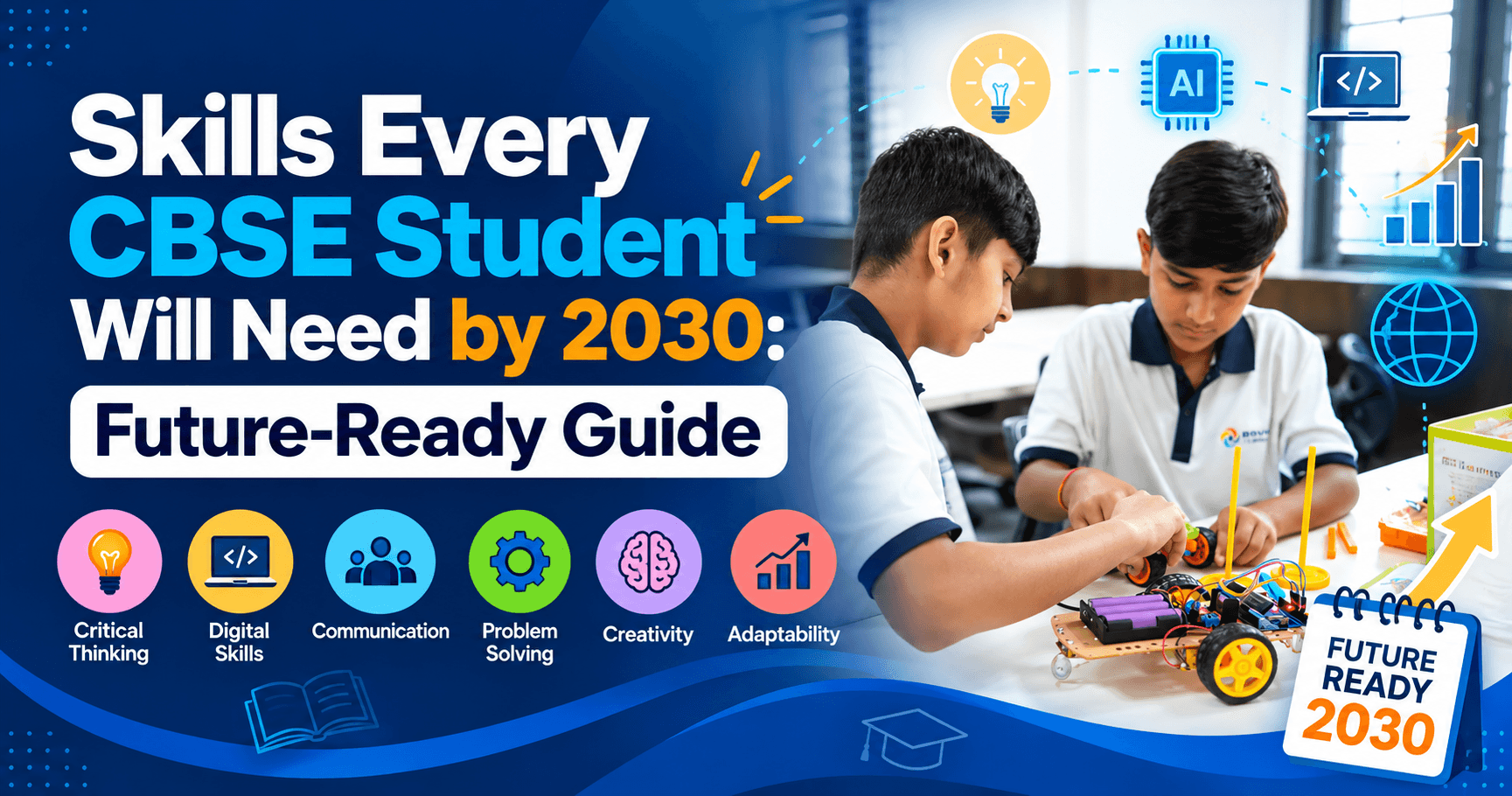
Students have always been studying for examinations in school. It has not always been ready for what comes after. The 21st century skills for students that really matter, the skills students need by 2030, are not just about marks and “rank.” This guide is here to explain them in a simple way, what they are, why they’re important, and how a student at the CBSE level can begin to develop these future-ready skills for students now.
Why 2030 Is the Real Deadline
A 9th or 10th grader today will be a college student or entering the workforce in about 2030. The skills for students in 2030 will be quite different from those they need today, and much more different than those required five years ago, due to a job market that is already different, the increased automation and technological nature of work, and the lack of empathy for skills that go no further than memorization.
It is important to understand future skills for CBSE students as the curriculum of CBSE is changing too, and competency based questions, project work, and skill subjects are gradually replacing pure recall based assessment. Students who develop the skills students need for the future at a young age are not only ready for the future, but they’re ready for the board exams of today.
Communication Skills for Students
It is the skill on this list that is used by nearly all of the other skills. Communication skills for students are not limited to speaking well, they also encompass writing clearly, listening well, and explaining an intricate concept in an understandable manner.
- Structured speaking (debate or class presentation)
- Frequent writing (apart from exam time), not for the sake of practice but for the sake of writing
- The ability to communicate a concept to someone who does not know it, a good measure of understanding
Good communication skills are essential in the workplace and lead to better job performance in interviews, group projects and leadership positions in the future, whether it is in their chosen careers or in everyday life.
Digital and AI Skills
Technology comfort isn’t a luxury, it’s a must beyond knowing how to use an app.
The digital skills for students are: a basic logic to code, comfort to use online research tools, and knowledge of responsible and efficient use of digital platforms, not only for entertainment.
The more recent and swiftly expanding aspect of the image is AI skills for students. This isn’t to say that all pupils should be programmers. It involves knowing what they can and cannot do, as well as knowing how to use AI tools for the purpose of learning rather than getting a “lift” from them without real grasp.
Life Skills for CBSE Students
You can’t tell from a student’s academic success whether he or she will be a successful adult.
Life skills for CBSE students are the skills that can’t be explicitly taught in school, basic financial skills, time management, emotional management and even making decisions without others telling what to do. While there has been a notable progression by CBSE integrating life skills aspects into the curriculum, there is definitely a need to reinforce the same at home and through personal practice.
Career Skills for School Students
There are some skills that benefit a student regardless of what stream they choose or career path they follow.
The career skills for school students that are good to work on are: being able to handle a project, collaborate in a team, take criticism but not personally, and set goals and follow through. These skills are applicable to all career areas including engineering, arts, etc. and are valuable regardless of a student’s future career goals.
The Full List: Essential Skills Every Student Should Learn
To sum up, here is a concise list of the essential skills for school students in this guide, the skills every student should learn.
| Skill Area | What It Covers |
| Communication | Effective oral, written, and listening skills |
| Digital literacy | Scratch and safe, effective technology use in a logical way |
| AI literacy | Responsible use of AI tools as a learning aid |
| Critical thinking | Interpreting information, challenging beliefs |
| Life skills | Financial education, time management, emotional management |
| Career readiness | Collaboration, flexibility, planning for goals |
| Creativity | Competency: problem solving with more than one right answer |
The skills that add up over time, communication, digital literacy and adaptability, are the best skills to learn as a student, more important in the long-term than any one technical skill acquired individually.
How CBSE Students Can Start Building These Skills Now
This doesn’t need to be taught by school. Most of these skills can begin to be developed by the student in their daily decisions.
- Participate in debate, quiz or public speaking events on a regular basis, not just once a year
- Re-check understanding, not bypass the thinking process altogether using AI tools
- Develop the ability to operate on a limited budget, or with a personal timetable
- Collaborate effectively with peers on group projects (not just assignments with disjointed tasks)
- Read beyond the syllabus frequently, as this will help develop a combination of communication and critical thinking skills
It’s best to develop CBSE students future skills in the context of the CBSE course, over years, rather than as a checklist aimed at college applications just before the start of the year.
Final Thoughts
Skills are not always rare or difficult to acquire, they are all about communication, digital and AI literacy, skills for daily life and adaptability. The key difference between a student who develops these skills well and a student who doesn’t is practice, regular practice, started early rather than as a last-minute jump-in. A student who works on these in addition to their core curriculum is likely to be better prepared to take on whatever follows school than any single set of marks.
FAQs
1. Do these skills or abilities matter more than grades in the classroom?
Not as an alternative to marks, but in addition to marks. While good grades remain requirements for college admissions and exams, it is the ability to apply that information which is being determined in college, work, and daily life.
2. How can a student learn AI without any technical knowledge in the CBSE board of education?
Begin by doing simple things first, like using AI tools to clarify complex concepts, to test your comprehension or to receive feedback on your written work. The intent is learning to use these tools wisely, not learning to make the tools.
3. Is this a skill that is already taught by CBSE in the curriculum?
Partially. CBSE has initiated skill subjects, life skill components and competency based assessment, but there is a considerable amount of skill development in terms of activities and habits that occur beyond the classroom.